Direct answer: brief the harvest and the routine, not just the planting style
An edible-garden brief should settle what the household wants to harvest, how often someone will tend it, the usable sun and shade, safe access to every bed, soil and container strategy, irrigation zones, pest monitoring, seasonal replacement and where tools and garden waste go. It should distinguish everyday herbs from crops that need more space or frequent replanting. Resolve these points before beds, trellises and irrigation are installed, because the garden's success depends on repeated care rather than its appearance on handover day.
Define what a useful harvest means
Start with the kitchen. List herbs, leaves, vegetables or fruit the household actually uses, the quantities that would be welcome, and whether the priority is convenience, learning with children, seasonal variety or greater household production. Then compare that ambition with available weekly care. Avoid promising self-sufficiency without a quantified growing plan. Dubai Municipality's homegrown-produce programme highlights sustainable domestic agriculture, irrigation methods, plant health, waste handling and responsible inputs; those are useful briefing themes even when a private garden is not part of a competition.
- Frequently used herbs
- Short-cycle leaves or vegetables
- Trellised crops where suitable
- Longer-term fruit or perennial plants
- Seasonal experimentation area
- Realistic weekly care time
Survey sun, heat, wind and convenient access
Map the site at more than one time of day. A bed that appears bright in the morning may receive intense afternoon exposure, reflected heat from paving or drying wind. Also map the walking route from the kitchen, hose or irrigation source, tool storage and waste point. Daily herbs belong where they can be reached easily; experimental beds can sit farther away. Provide working access without stepping into cultivated soil, and decide how temporary shade or seasonal supports will be fixed without damaging services.
- Morning and afternoon sun
- Reflected heat from walls and paving
- Prevailing and channelled wind
- Kitchen-to-garden route
- Reach to both sides of each bed
- Space for baskets, tools and seasonal supports
Choose beds, containers and soil as one system
In-ground beds, raised beds and containers each change drainage, soil volume, heat exposure, access and replacement work. A raised bed can improve reach but may dry more quickly; a container gives flexibility but has limited root volume. Ask the landscape team to define the growing medium, separation from unsuitable existing soil, drainage path, edge material and renewal plan. Inputs used around food crops should be selected and managed appropriately; the brief should not assume that every ornamental-garden product belongs in an edible area.
Develop planting and irrigation together
Group plants by water need, root space, exposure and expected replacement cycle rather than arranging them only by colour. Show which beds change seasonally and which contain permanent plants. The irrigation plan should allow those zones to be adjusted and observed without soaking paths or seating. Record emitter approach, zone boundaries, controller assumptions, isolation and the way temporary crops are reconnected after a bed is refreshed. Final hydraulic design and installation should be completed by competent specialists using the actual site conditions.
Plan plant health and hygiene without overpromising
An edible garden needs regular observation for pests, stress and disease. The brief should state who monitors plants, how affected material is isolated or removed, and where tools are cleaned and stored. Dubai Municipality describes integrated pest management within its public-health work and considers integrated control, responsible inputs and plant health in its homegrown initiatives. Product selection and treatment advice should come from qualified sources for the crop and setting; this guide does not prescribe pesticides or application methods.
- Routine leaf and soil observation
- Clear route for removing affected plant material
- Separate storage for tools and inputs
- No unsuitable runoff into edible beds
- Supplier records for plants and growing media
- Escalation to qualified advice when problems persist
Planning example
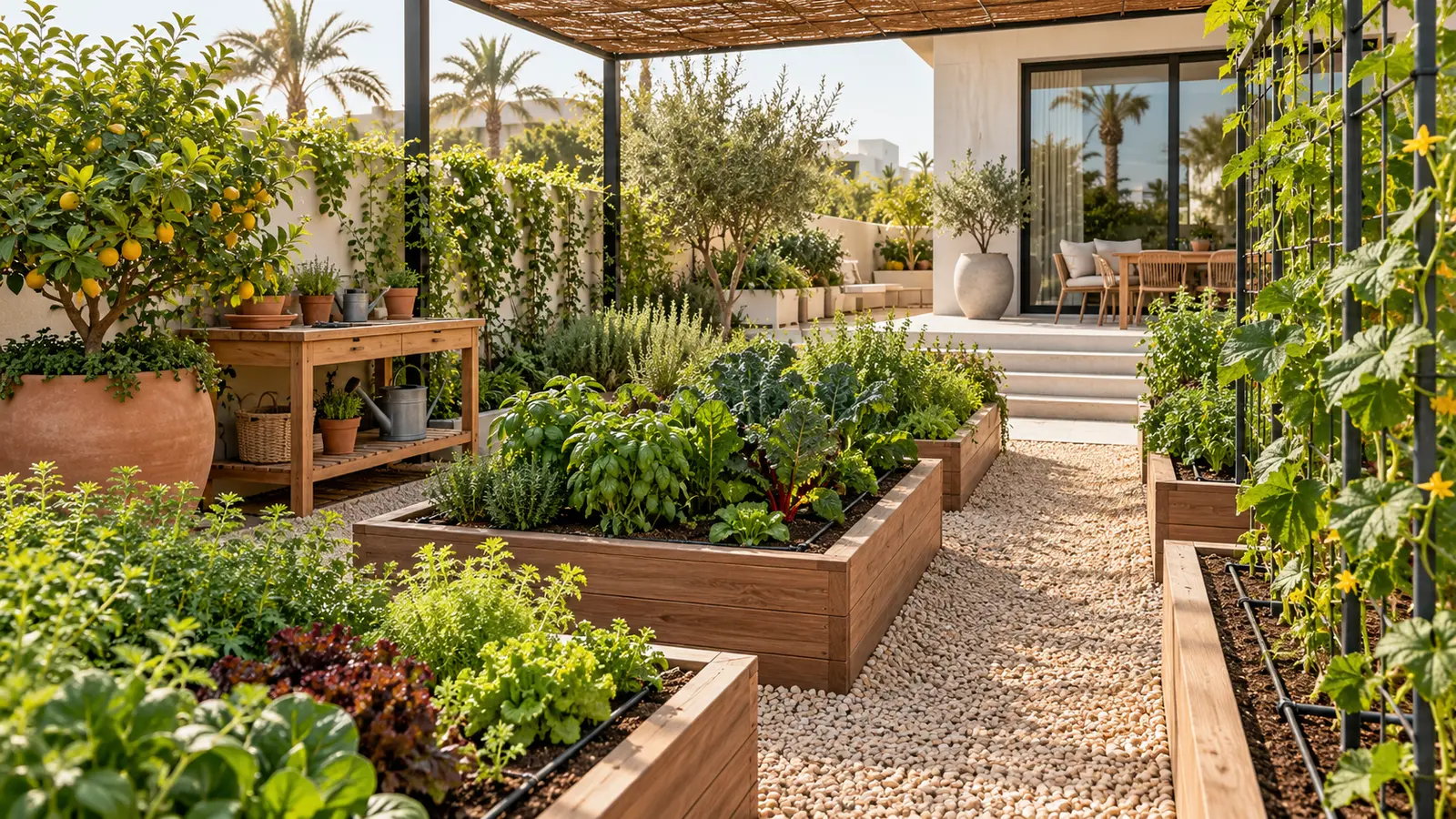
A fictional household wants herbs every week, salad leaves in the cooler season and a small citrus collection. The first concept scatters edible plants through ornamental beds, making harvesting and irrigation adjustment difficult. The revised brief creates two raised beds near the kitchen, a trellis bed with seasonal shade provision, and citrus in generous containers along a serviceable edge. Herbs occupy the nearest bed; experimental crops use the second. Each area has a documented irrigation zone and renewal plan, while a shaded bench holds baskets and clean tools. The example is a planning model, not a promised yield.
- Frequent harvest is closest to the kitchen
- Seasonal beds can be reset without disturbing permanent planting
- Containers and beds have distinct irrigation needs
- Every growing area is reachable from a path
Checklist before beds and irrigation are ordered
Review the following points with the household, landscape designer, irrigation specialist and plant supplier.
- Harvest goals and maintenance time agreed
- Sun, reflected heat and wind mapped
- Beds and paths checked for safe reach
- Growing medium and drainage strategy documented
- Permanent and seasonal planting separated
- Irrigation zones match plant groups and replacement cycles
- Tool, input and garden-waste locations shown
- Plant-health monitoring responsibility assigned
- Shade and trellis fixings coordinated
- Seasonal review and replanting dates planned
Limits and the next useful step
Crop suitability, yield, irrigation demand and seasonal timing depend on site microclimate, plant variety, soil, water quality and care. A concept cannot guarantee harvests or replace advice from qualified horticultural and pest-management professionals. The next useful step is a one-week site observation and kitchen-use log. Bring the results to a measured garden workshop and issue a coordinated bed, access, planting and irrigation brief before ordering materials or plants.
Sources & further reading
Make this useful for your project.
A review of your property and priorities can turn general guidance into a defined brief.
Explore Landscape designDiscuss your project